Showing posts with label pork. Show all posts

Friday, July 3, 2026

thịt kho tàu 3.0

Third iteration of this dish, which I first made about two decades ago. Still cooking as of this writing, but I think it's going well. An IG post will prove it. I used to call this thit heo kho, but apparently that is a more general term for braised pork stew. This is the more precise name, which refers to this dish cooked in caramel, fish sauce and coconut water. 

INGREDIENTS

1kg pork belly, cubed (adobo cut)
1 cup sugar (brown or muscovado preferred)
3/4 cup fish sauce
1/4 cup water
1 onion, minced
1 garlic, minced
500mL coconut water 
6 hard-boiled eggs

1. Heat the sugar in a large pot over low heat, stirring often to prevent burning. This will take a while and a bit of effort, but trust the process and the sugar will eventually turn into a syrupy caramel (try not to burn the thing). 

2. Mix the fish sauce and water and put it into the pot. This will cause your hard-worked syrup to solidify into a salty, fishy clump of candy, but trust the proccess. Continue cooking the "candy" into the fish sauce liquid until it is all dissolved. 

3. Put the onion and garlic into the pot and cook until it's aromatic. Some recipes call for cinnamon and star anise at this point, but I like to keep it simple. 

4. Now this is a tip from Tra's mom: turn off the heat, put the pork into the pot and let it marinate for 30 minutes. It will cool down, yes, but that's the point. 

5. Pour in the coconut water and simmer over low to medium heat for about 30-40 minutes,  

6. In the last 5-ish minutes of simmering, add the hard-boiled eggs. 

Serve with steamed rice and greens. 

Wednesday, February 10, 2021

Thịt kho tàu 2.0

I've been making this dish, or at least a version of it, since my bachelor days. In fact, I wrote a recipe on this blog about 13 years ago (see it here). I've since been told not to use that name, and I now have better tools than my old single-coil electric stove. This one is for the Instant Pot which, as you'll see if you read the recent posts on this blog, has been my galley gear of choice these days. It also borrows some elements from this recipe for 红烧肉 (hong shao rou), which is another dish I want to try making. 

Ingredients
1 kilo pork belly, cubed
1 onion, chopped
1 garlic, chopped
3/4 cup brown sugar
1 1/4 cups coconut water
1/4 cup fish sauce
ground pepper
1 star anise
1 cinnamon stick
canola oil

1. On Saute, heat up a bit of oil then add the sugar. In my experience it started out a bit clumpy, but it eventually started to melt. When the hot oil-sugar mixture is mostly melted (with a few clumps) add a mixture of 1/4 cup fish sauce and 1/4 cup coconut water. Heat this up and use this to fully dissolve the sugar. 

2. Add chopped onion and garlic and simmer until you can smell the aromatics through the caramel and fish sauce. 

3. Add the pork and generously season with pepper. Simmer a bit until pork is a bit browned/denatured on all sides. 

4. Add 1 cup coconut water, star anise, and cinnamon. Simmer for a while. Then, if you have time (I did), Slow Cook for 4 hours. This will help extract all the flavours. 

5. Check tenderness of meat. If needed, Pressure Cook on High for about 20 minutes and NPR until meat is very soft and fat is rendered. 

6. Continue simmering on Saute until desired sauce thickness. 

You may add hardboiled eggs or tofu in step #6 for a more festive dish (they do serve this for Tet). Serve with steamed rice and greens. 

Thursday, February 4, 2021

Next in the Galley: Marosszéki Heránytokány


So I ordered 2 x 500g of beef brisket with the intention of making Tass Kabab e Aremaneh. Instead, what arrived as 500g of beef brisket and 500g of pork ribs. I'm pretty sure Iranian tass kabab will not be very authentic if I use pork, so I looked for a stew recipe that contained both beef and pork. I found this dish (recipe from here and here), which is apparently claimed by both Hungarian and Romanian cuisines. Seems the distinctive flavour will be coming from paprika (because Hungary, of course), marjoram, caraway, sautéed mushrooms, and sour cream. Interestingly, there is no garlic anywhere in this dish and wondered if a link with Transylvanian nobility of the literary kind is the Romanian side of the dish. Of course, I plan to make this using the Instant Pot.  

Ingredients
500g beef brisket, cubed
500 pork ribs, cubed
bacon or Speck, chopped
1 onion, chopped
button mushrooms, sliced
a pinch of caraway (or fennel) seeds
1/2 teaspoon marjoram
1 tablespoon sweet paprika
1/2 cup water
1 cup white wine
sour cream
canola oil (something neutral-tasting)
salt and pepper to taste 

1. In the Instant Pot, press Saute and sauté bacon then onion in oil until brown and aromatic. Add paprika mixed with water and bring to a simmer for a few minutes. 

2. Add beef, pork, spices, and wine and Pressure Cook on high for about 50 minutes then NPR. While pressure cooking, in another pan sauté the bacon and mushrooms until mushrooms are browned and lose a bit of moisture. 

3. After pressure cooking and meat is nice and soft, press Saute and reduce the sauce until desired thickness. Stir in sautéed mushrooms and bacon. Simmer a bit. 

4. Before serving, fold in some sour cream to enrich the gravy. 

Usually served with a crusty bread or baked potatoes, but we will probably have this with steamed rice. 

Sunday, January 17, 2021

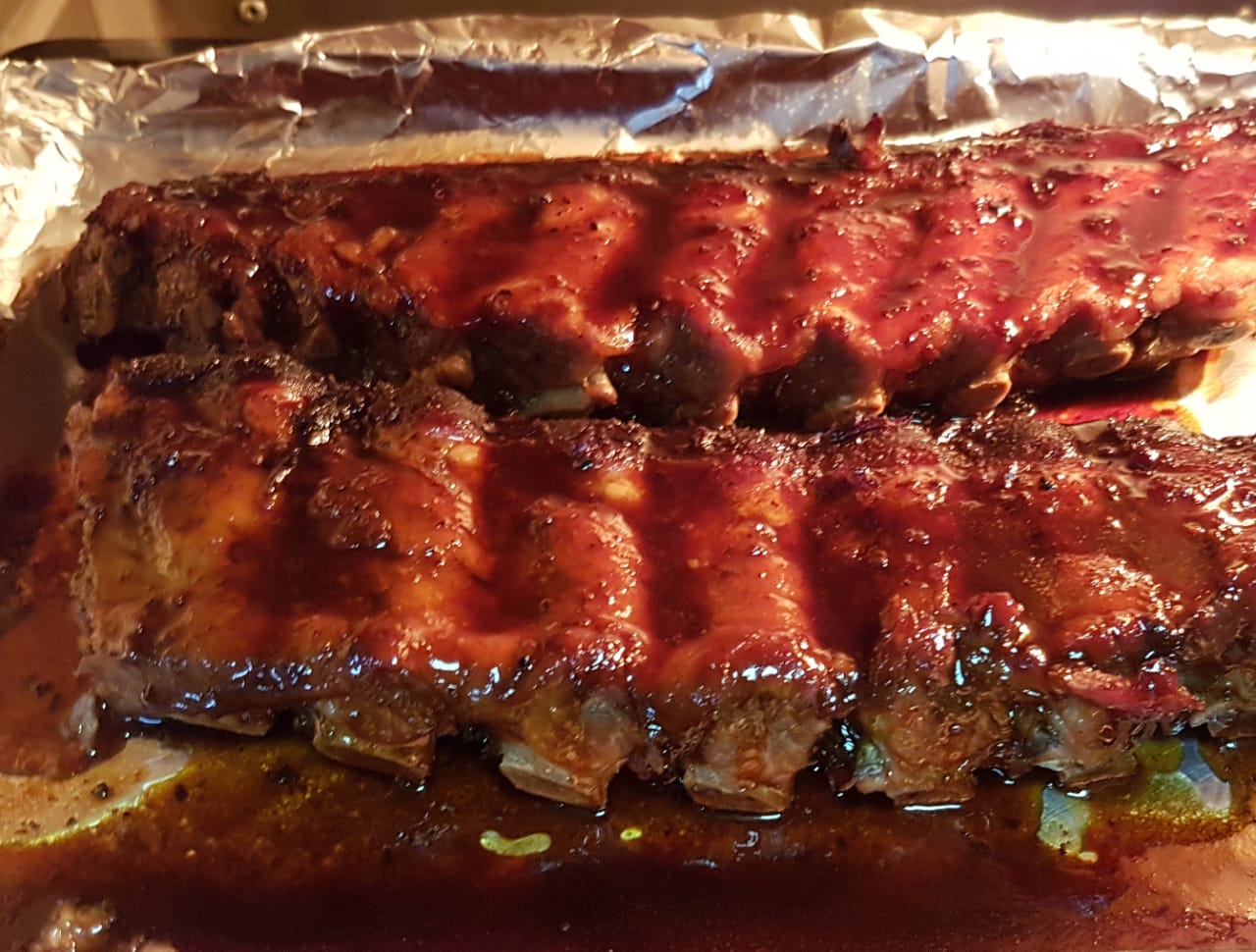
Teriyaki Pork Ribs 1.0


Logging for notes. There are a few thinks I need to tweak-- texture is good (not too soft), but the meat's flavour apart from the sauce could be better. Not bad for a first try.

Ingredients
1 kilo baby back ribs
3/4 cup teriyaki sauce (I used Kikkoman Teriyaki Marinade)
3/4 cup hon mirin
knob of butter
salt and pepper

1. Season the ribs and marinate in teriyaki sauce and mirin, preferably overnight (I only did 2 hours, hence the lack of flavour). 

2. Place ribs and marinade in the Instant Pot. If you have a trivet, rub salt and pepper on the ribs and place on the trivet. Pressure cook on high for 40 minutes, natural release for 10 minutes, then quick release. 

3. Place ribs on a baking tray, keeping the now-watery marinade in the pot. Add a knob of butter and Saute on high to reduce the sauce until it can coat the back of a spoon. 

4. Bake ribs at 220C until desired brownness. 

Serve with rice (or course). 

Wednesday, February 27, 2019

Next in the Galley: Mechado

MOM'S MECHADO

Literally how my mom used to make it.  

Ingredients: 

1 kilo beef threaded with pork fat
garlic, onions and tomatoes, minced
1 small can of tomato sauce
potatoes and carrots, cubed
2 laurel leaves
1/5 to 1/4 cup soy sauce
ground pepper

Actual email: You can get a 2 lb. (a kilo) slab of beef, insert pork fat in the middle (in Manila, i'd get it from Rustan's or SM supermarkets prepared that way). You can thickly slice it and put in a pot. Mince garlic, onions and tomatoes, then place on top of the meat. Add a small can of tomato sauce. Add water using the same small can. Add pepper and soy sauce, around 1/4 cup. See, am not into measurements so be careful in adding too much soy sauce at once. When beef is almost done, taste.
Better to cook it slowly. Enjoy!


NINANG ETANG'S MECHADO (from Positively Filipino)

Ninang Etang's Mechado leaves required threading of the fat to the cook's imagination.  From "Recipes of the Philippines" by Enriqueta David-Perez, pioneer food editor of Manila.  The book was in its 19th print as of 1973.

Ingredients: 

1 kilo beef, lean
4 big onions, whole
1/2 cup vinegar
Strips of pork fat
1 can tomato sauce (small)
6 potatoes, cut in halves
1/2 laurel leaf
2 tbsps. fat
1 tsp. pimenton
Salt to taste

1. Insert fat strips lengthwise in beef.

2. In a deep pot or pan, place the meat, laurel, tomato sauce, vinegar, salt to taste and water to cover.  Cover and simmer until tender.

3. Add potatoes, onions and pimenton and continue cooking.

4. When most of the broth has evaporated and potatoes are cooked, add the fat and stir well.

Serve meat sliced crosswise.

Monday, December 10, 2018

Next in the Galley: Cemita Poblana

I want to make this sandwich for the Boy. Ok, for myself, but the Boy will surely like it too. Recipe is from here, but modified for my circumstances.

Ingredients

beef, pork, or chicken cutlets (e.g., Taiwanese chicken chop or German Schnitzel)
avocados, halved, pitted, and sliced
cemita buns, sesame-seed buns, or brioche buns, halved
string cheese, divided
raw onion rings (about 1/4 inch thick)
chioptle chiles or pickled jalapeños
fresh cilantro leaves
extra-virgin olive oil, for drizzling

1. Spread avocado slices on bottom bun halves. Top with fried cutlets. Mound half of the cheese on the cutlets.

2. Arrange onion rings on top of cheese. If using chipotles, tear into pieces and arrange on onion rings; alternatively, arrange pickled jalapeños on top of onion rings. Top with cilantro and mound the remaining cheese on top. Drizzle with olive oil.

3. Close sandwiches and serve right away.

Had to make do with what I could find at the neighbourhood FairPrice. No sesame seed buns or brioche buns, so used whole wheat burger buns instead. Replaced with Oaxaca cheese with Bega Stringers and the nopales with cilantro. The Boy loved it: https://www.instagram.com/p/BrZ6qC6BdnL/

Back in the Galley: Bellychon

I've made this dish twice now, and the second one was better than the first. Still need to find my perfect technique for the skin though.  

Ingredients:

1 kilo pork belly, whole and skin-on
insane amount of minced garlic
smashed lemongrass stalks
laurel leaves
ground pepper
salt
spices, chilies, peppers, other accoutrements (optional)

1. Prepare the pork belly. Ensure that there isn't too much hair on the skin; there's a scorched skin method to get rid of the hairs (see dong po rou recipe below for a video). Also better if the belly is sliced fairly evenly so it can roll up nicely.

2. Generously rub salt and pepper onto the meat and skin. Lay the belly skin-side down and layer garlic, lemongrass, and bay leaves. You can also add other spices here, although I prefer to keep the flavourings simple.

3. Roll up the belly and tie with twine. Cover with aluminium foil.

4. Preheat oven at 180C and roast for 1 hour or so for every kilo of meat. I use a rotisserie oven so I am not too concerned about heat distribution or repositioning of the meat: I set the oven to broil so the heat comes from the top.

5. Raise heat to 200-220C. Remove aluminium foil and continue roasting until skin starts to brown. After about an hour you need to check in more often to make sure the skin is crisping evenly. You may need to regularly reposition the meat to make sure that the skin that needs the most attention is closest to the heat source. Some tips for helping the skin to crisp are to prick the skin pre-cooking, baste with oil, or baste with milk (to make it red). I used the pre-pricking method.

6. When skin is done, or as crisp as it will ever get without burning, take out the roast from the oven and let it rest for at least 10 minutes before you start slicing.

Serve with sinamak (dipping sauce of spiced coconut vinegar), tomato/herb salad, and steamed rice. Goes well with a robust red wine.

A few pictures:
https://www.instagram.com/p/BrH9rvphZB2/
https://www.instagram.com/p/BrIDVzghuEL/
https://www.instagram.com/p/BlfXj5Fn7x0/ (first attempt)

Tuesday, March 13, 2018

Next in the galley: Dong Po Rou

From: http://mb.ntd.tv/2018/03/07/braised-pork-belly-dong-po-rou/

Braised Pork Belly (Dong Po Rou)
Ingredient:

1000g (2.2lb) Pork Belly
1000g (35 oz) Cooking Wine
200g (7 oz) Soy Sauce
150g (5 oz) Rock Sugar
300g (10.5 oz) Green Onion
300g (10.5 oz) Ginger
300g (10.5 oz) Garlic
1 Piece Bamboo net

Directions:

1. Removing hair on pork skin. Heat up wok, When it hot, put in pork belly with skin side down and push it against wok bottom to burn hair on it.

2. Add water, let pork piece immersed in water, bring to boil for a few minute, turn it over keep boil for another a few minutes. This is to remove blood in meat. Take it out and drain water.

3. Cut pork into smaller pieces.

4. In a wok, layering bamboo net, green onion, ginger and pork pieces on top with skin side down. Then add in all other ingredients, cover and simmer for 90 minutes.

5. Put meat and sauce in clay bowl, steam for 3 hours.

6. Ready to serve .

Saturday, February 13, 2016

Back in the Galley: Paella


So I'm happy to say that I'm cooking again. I returned to the galley last week when I cooked thit heo kho after seven years; prior to that, the only dish I cooked from scratch in the last six years was that pork adobo two years ago. This week I tried my hand at making paella, a dish that has always intimidated me. I was not sure if it was going to be edible, so I was very conservative with my ingredients (especially the saffron). Well, it turned out better than I expected. The rice was nicely cooked and very flavourful-- not bad for a first attempt. I could think of several things I could've done better-- I should've pre-fried the pork; I should've used a short-grain rice; I should've managed the heat better to get  a good crust-- but overall I'm happy with this dish, and so were my Dear and the Boy. This is a gateway dish for me: plov, you're next. 

Here is the recipe I used today. There are better and more authentic paella recipes out there, but this is the one I made today. It's my #achievementunlocked moment, so I'm saving it. 

Ingredients: 

extra virgin olive oil
1 onion, chopped
1 garlic, chopped
1 tomato, deseeded and chopped
1 spicy chorizo, sliced
1/2 kilo pork ribs, pre-cooked (braised or fried)
1 can chopped mushrooms
2 cups uncooked rice, rinsed (preferably short-grain like Bomba, Calrose, or Koshihikari, but I used long-grain Hom Mali and it turned out ok, quite loose and fluffy like plov)
smoked paprika
pinch of saffron
salt
ground pepper
500 mL chicken stock, simmering
water, simmering

1. On a wide, shallow pan (ideally a paellera), saute the onion, garlic, and tomato in generous amounts of olive oil. When you can smell the aromatics, add in the chorizo.

2. When you have a good saute going, add in the pork. If it's pre-cooked, just heat it up enough and get some good browning; if it's raw, slow down the fire a bit so you don't burn the other ingredients while waiting for the pork to brown. You can also season the raw pork with salt and pepper at this point. In the last minute or two of browning the pork, add in the mushrooms.

3. Pour in the simmering chicken stock and the spices (paprika, saffron, pepper, salt); any liquid you add should be hot to avoid drastic temperature changes in the pan. Bring to a boil.

4. Add in the rice, distributing evenly throughout the pan (you can also take this time to rearrange the ingredients nicely). Bring to a boil, then bring down to a simmer and cover. Do not mix the rice, lest you end up with a creamy, risotto-like paella. This is the part where it gets tricky. Ideally you'd have put enough liquid to cook the rice, but if the liquid runs out prematurely add in some hot water to compensate. I had to do this a few times-- not an ideal situation, but not catastrophic either.

5. Simmer the rice until done (about 15 minutes). Top with remaining mushrooms or fresh herbs and let the latent heat warm them up.

Garnish with lemon wedges or sliced calamansi. We ate this on its own, but you could also serve with some greens to cut the richness. Goes well with a dry white wine.

Paella #2 (a.k.a. plovella):
A photo posted by xsaltire (@xsaltire) on
Paella #3:

A photo posted by xsaltire (@xsaltire) on

Paella #4:


Monday, September 12, 2011

Treffpunkt

Means "meeting place" in Austrian. It's also an Austrian deli/restaurant along EDSA that I've been seeing since the 1980s as a kid. We used to live in Las Piñas but most of our relatives were in Quezon City so we we'd pass by the place on our way to reunions.

I've always wondered what was there. Good thing they have a very informative website here, which looks like it was designed in the 1990s. Not that I'm complaining since it has everything I needed to know.

Now to actually visit the place.

Thursday, March 24, 2011

Mom's Meatloaf Recipe

Yeah, it's been a while since my last (non-)post. It's not as if anyone's reading this blog anyway. Oh well.

Here's my mom's meatloaf recipe, which she began making sometime in the late 1980s, then stopped, then made it again in the mid 1990s. When I was single it was sort of a staple since it's very easy to do and keeps/reheats well. My Dear loves it, and I guess it contributed to how history eventually turned out. Resulting in Lucas. Hehehe.

This recipe is supposed to be a family secret of sorts, but I'm posting it anyway. Given this blog's active readership, I figure it'll remain a secret for some time to come.


Ingredients:

1/2 kilo ground pork or beef (or both)
1 can Campbell's Cream of Mushroom soup (Campbell's just tastes better)
2 eggs
about 1 cup bread crumbs (optional)
1 garlic, minced
freshly ground black pepper (to taste)
soy sauce (to taste)
whatever you feel like chucking in (more on this later)

1. Thoroughly mix everything together. By hand. In a big bowl.

2. Aside from the basic ingredients, feel free to chuck in any other spice or minced ingredient you want. For flavourings I've used curry mixes, Old Bay, Cajun spices, and Italian seasoning. Minced ingredients I've used include olives (green and black), onions, chorizos, salami, hotdog, spam, Mexican chiles, and even sweet ham. Just remember to do (1) so everything is a homogeneous slurry.

3. Cook. As a bachelor I actually microwaved this for 35 minutes in a glass dish covered with wax paper-- it came out with gloriously burnt edges. But if you're more comfortable with steaming or baking, go ahead.

Serve with your choice of carb.

Monday, March 22, 2010

Estofado de Lucas

It's been a while since my last post. Between my Floyd memorial and this post I moved residences and had a new position at the Bank. And I became a proud father to my son Lucas. I name this dish after our little boy because this truly is a fusion of my Dear's and my cooking styles. And it can give you a good kick.

Ingredients:

1/2 kilo pork, cubed (menudo cut)
1/4 kilo potato marbles, halved
about 6 medium tomatoes, diced
1 onion, chopped
1 garlic, chopped
dried chile pods (I used chile Arbol)
fish sauce (patis)
fennel seeds, about a pinch or two
black pepper, coarsely ground
cooking oil (I used canola oil because of its neutral flavour)
2 cups stock, chicken or beef

1. Brown the pork in a stew pot. Hold on to the spices for now-- don't put anything on the pork, just chuck it into the pot and cook until all the liquid evaporates and the fat starts rendering. A few brown pieces is good. Set the pork aside.

2. Using the same pot, heat up some oil fry the black pepper, fennel seeds, and dried chile pods until you start to smell them. Put in the onions and garlic and fry them until they release their aroma as well.

3. Chuck in the tomatoes. As they're frying (and releasing their lycopene into the oil, turning it red), mash the tomatoes so you'll get a light quasi-tomato sauce in the pot. Don't use canned tomato sauce as the tomato flavour will tend to overpower the dish-- nothing really beats beating fresh tomatoes into a pulp. Season with some fish sauce to taste and to add a slight fermented layer to the flavours. At this stage you can actually use this sauce on pasta.

4. Chuck in the pork and stir. Bring up the temperature in the pot and fry the pork in the sauce for a while. Then chuck in the potatoes and fry some more, stirring to make sure that the sauce/oil coats every piece of potato. Let it all fry on high for about five minutes until they're all happily blended.

5. Pour in the stock, bring to a boil, then reduce heat to medium and let the pot simmer. Stir from time to time. Reduce the sauce to the desired thickness and turn off the heat.

Let it stand for about 15 minutes to let the flavours mature then serve with steamed rice.

Monday, March 9, 2009

Ethiopian Pork We't


My version of we't (also written as wot or wat), the classic Ethiopian stew.  My Dear and I first tried this dish at Ziggurat, which was more authentic and made of chicken (doro we't).  According to this article, Ethiopians don't eat pork, so there's my first departure from tradition.  Second, this dish should be made with spiced clarified butter (niter kibbeh) and garnished with hard-boiled eggs.  What makes this pork dish we't-style, however, is the cooking method for the onions and the use of berbere spices.

Ingredients:

1/2 kilo pork, cubed (menudo cut is best, but I used adobo cut)
2 medium onions, finely chopped
1/3 cup vegetable oil (avoid olive oil as it has a strong flavour)
approx. 1/8 cup berbere spices*, depending on taste
3 medium potatoes, cubed
3 eggplants, cubed
1 lemon
2 cups water

1.  Prior to cooking, marinate the pork in lemon juice.

2.  Cook the onions in an ungreased stew pot until their are dark brown and mostly dry, stirring often to avoid burning.  Remove the pot from the fire from time to time if the heat gets out of hand.  This process, which caramelises the onions that will form the base of the sauce, is an essential step in making we't.

3.  Pour in the cooking oil and berbere spices and mix well.  Chuck in the pork and potatoes and fry until pork changes colour.  

4.  Pour in the water, bring to a boil, then lower the heat and leave to simmer.  Braise the pork for about an hour until most of the liquid has reduced.

5.  When the water has mostly evaporated put in the eggplants and continue cooking until they are done. 

For a more traditional we't: (1) use chicken or lamb instead of pork, (2) replace the oil with butter, and (3) put some whole hardboiled eggs during the last 5 to 10 minutes of cooking.  This should be served with some injera bread, but pita bread will do.  Since we already broke more than a few traditions, we ate our we't with steamed rice.

---

* You can make your own berbere spice mix with cayenne pepper (or any chilli powder), paprika, black pepper, ginger powder, and ground coriander.  The cayenne pepper and paprika should make up most of the spice mix, then add the other spices according to taste.

Monday, February 23, 2009

Jamaican Jerk Porkchops


"Jerk" does not refer to the one cooking but to the jerk spice mix from Jamaica.  "Jerk" in this case comes from the Quechua charqui, which means dried meat and is the origin of the word "jerky", that staple of, er, people who can probably relate to Larry the Cable Guy.  Jerk spices, whose main ingredients are ground allspice and chilli powder, are used to cure dried meat and as a dry rub for barbecues.

Ingredients:

pork chops, butterfly cut
Jamaican jerk spice mix*
red bell peppers
soy sauce (optional)
Worcestershire sauce (optional)
vegetable oil (optional)

1.  Rub the spice mix on both sides of the pork chops.  For more flavour, marinate the meat in some soy sauce and Worcestershire sauce before rubbing in the spice mix.

2.  Slice the bell peppers and lay them on the pork chop so they cover half of the area; fold over the pork chop (hence, the use of the butterfly cut).  You will have some pork chop "sandwiches" with bell pepper and spices in the middle.

3.  Grill until well done; better to use a contact grill so that you will blacken the pork chop.  For more flavour and added moisture, drizzle some oil on the pork prior to grilling.  Take care not to overcook them, lest they dry out.

Serve with steamed rice and a side of salad.

---

* Most important elements are equal parts allspice and chilli powder (e.g., cayenne pepper).  You may also add other dried herbs and spices such as black pepper, paprika, thyme, garlic, onion, ginger, or cinnamon.

Wednesday, February 11, 2009

Estofado de San Miguel


Spanish-style pork stew with chorizos, potatoes, and three kinds of chiles (bell peppers, dried arbol chiles, and paprika), cooked in San Miguel beer.  I just made this up, but I'm sure there's a traditional recipe just like this somewhere in Spain.  Gave me a chance to use one of the Tefal stew pots we got for our wedding (thanks, Law friends).

Ingredients:

1/2 kilo pork, cubed (adobo cut)
2 long links Spanish chorizos (raw, not dried), sliced into chunks
1/3 kilo potatoes, cubed
3-5 bell peppers (depending on size), chopped
1 bottle San Miguel beer
1 garlic, chopped
1 onion, chopped
3-5 dried chile pods (dried chile flakes could also be used)
1/2 cup vinegar
1/4 cup canola or olive oil
coarsely ground black peppercorns
paprika
fennel seeds
laurel leaves

1.  Heat up the cooking oil in a stew pot and fry the dried chiles, ground peppercorns, laurel leaves, and fennel seeds until you start to smell them.  Add garlic and onion until they start to brown.

2.  Add chorizos; this will cool down the pot so wait for the temperature to go back up.  Fry chorizos until lightly cooked and oil turns red; add bell peppers.  If you have time, it would be good to roast then peel the bell peppers prior to cooking.

3.  Add pork and cook until lightly brown or at least until the pork loses its raw colour.

4.  Add potatoes and paprika.  Bring the pot temperature back up and make sure potatoes are well coated with oil.

5.  Pour in vinegar and beer, making sure there is enough liquid to cover the pork, etc.  Quickly bring pot to a boil then bring it down to a simmer.  Cover pot.

6.  Let the stew simmer for about an hour or until most of the liquid has reduced and you are left with a reddish sauce.

Serve with steamed rice and some greens.

This dish is very amenable to reheating as the flavours become stronger after time in the ref; best to reheat in a broiler so you get some crusty bits. I learned to make these kinds of dishes during my severely budget-constrained MA days, but back then I'd put a lot more potatoes than pork to extend the number of servings.  After the pork has gone the tasty potatoes and sauce can be turned into an instant Spanish omelette.

Sunday, February 8, 2009

Sunday Lunch

Sundays are a great day to stay in and cook, free from the busy hours of weekdays and the errands of Saturdays.  I usually set aside Sundays to make slow-cooking stews that we'll eat the rest of the week, sometimes in different reincarnations.  This Sunday, however, my Dear prepared for us a Filipino-Korean lunch, which, unholy as it sounds, actually worked.  I helped, of course, though it felt new to me to be relegated to prepping in what used to be my own kitchen.

For the Korean part, we had a side dish of sukjunamul (숙주나물), which is basically blanched mung bean sprouts seasoned with minced garlic, sesame oil, ground black pepper, vinegar, and soy sauce.  We put in a tad too much garlic on this one, resulting in a pretty pungent sukjunamul which I liked but my Dear found quite overpowering.


The main course was boiled-then-fried Tuguegarao longganisa, named after the capital city of Cagayan Province.  Compared to the more famous Vigan longganisa, the Tuguegarao longganisa has bigger links, a more yellow colour (thanks to atsuete), and a milder garlic taste.  To serve, they are first boiled in water to fully cook the sausage and render the fat; the links are pricked so they won't burst.  After the water has evaporated you are left with sausage links frying in their own fat, which then browns the longganisas.  


After cooking, we ate the sukjunamul and longganisa with steamed brown rice.  Although both dishes were strongly garlicky, they presented the ingredient differently-- raw and pungent on the sukjunamul while sweet and mild in the longganisa.  The fresh taste of the bean sprouts also complemented the fatty richness of the pork sausage.  For dessert we had some fresh
lakatan bananas, all washed down with senna leaf tea.

Saturday, December 13, 2008

Ride N' Roll Diner

We recently tried Ride N' Roll Diner over at Xavierville Avenue in Quezon City. Having opened around late November, it presents itself as a diner/music lounge/art gallery, with cheap beer. We went on a day without any band or exhibit, so the ambience was more like a casual eatery than an artsy place. Service was friendly and efficient, although at the time there were more waiters than customers. But they were very professional, which is a plus. The menu ranges from staples such as sandwiches and fries to more surprising fare (given the setting) such as baked oysters. Here's what we got:

Calamares (P165)-- The usual battered and fried squid rings, served with a mayo-based sauce. Not bad, but not spectacular either. The squid was cooked inconsistently, some were soft but others were quite rubbery. The batter remained crunchy enough, albeit a bit oily.

Pork Sisig (P145)-- Worst. Sisig. Ever. It was more onion salad than pork sisig-- it had more onion in terms of volume and probably in weight, too. And if you think the onion extenders would result in a larger serving size then you're wrong-- despite being spread so thinly the dish could barely cover half the sizzling plate's surface area. As for the pork bits, they were all greasy and fatty without any of the flavour that would make them edible. I've had much better sisig straight from the freezer. Sisig is usually a very forgiving dish; it's very difficult to mess it up to the point of being inedible. This dish managed to achieve that feat with flying colours. Congratulations.

Garlic rice (P25/cup)-- This was actually pretty good. The rice was well-infused with the flavour of garlic, and the crunchy garlic bits were a good garnish.

Maybe it does showcase good art and music from time to time. It does look like a good place to hang out and have a few beers or coffee. The service is good; beer is relatively cheap (P38/bottle). But from what we've had, steer clear of the food. My Dear has sworn off the place forever; I'm willing to give it a second chance.

Here are the scores:

Quality = 2.0
Size = 3.5
Taste = 3.0
Ambience = 6.0
Service = 6.0
Value = P63.33
Price = P125.00
Sulit Rating = 0.51 < 1

Being in the neighbourhood, I would like to have more good places to eat in the vicinity so I wouldn't have to drive to Katipunan or Kalayaan for a good meal. So far this place has been very disappointing; I hope my second visit, which will have very low expectations, will be a better experience.

Tuesday, October 14, 2008

La Cuisine Française in a can


More than elaborate sauces, expensive wines, and Michelin stars, the heart of French cuisine is really the common man's fare: the staple baguette, the hearty cassoulet, the cheap and easy ratatouille.  And of course there's choucroute, which I just tried from a can.

Choucroute is basically sauerkraut from France's Alsace region, which borders Germany.  The name itself is a francicised version of the German dish, from German Sauerkraut to Alsacian Sürkrüt to French choucroute.  Choucroute garnie is choucroute garnished with sausages and ham, and choucroute royale is choucroute made with premium charcuterie and wine.

I first heard of choucroute from Anthony Bourdain, so when I saw a can of it at Rustan's Fresh I just had to buy it.  The big can of choucroute, good for at least two servings, costs around P250.  Made by Belle France CIBON, it is marketed as authentic Alsacian choucroute royale made with Riesling wine.  The charcuterie is composed of two pieces each of smoked pork belly chunks and three kinds of sausages (Montbeliard, Frankfurter, and something that tastes like a mild chorizo).

I did not have particularly high hopes for choucroute coming from a can, so I was pleasantly
 surprised that this one actually tasted good.  The choucroute itself was mildly sour and matched well with the meats; however, it had a greasy aftertaste, surely because of the lard.  I ate it with slices of soft baguette from Annabel Lee (P75 for a big loaf).

At around P125 a serving it is quite expensive for a meal from a can, but it's quite reasonable for the closest thing to authentic French cuisine you can buy from a supermarket.

Thursday, September 18, 2008

My P1,000 Morning Food Trip

It started benignly enough. I woke up earlier than usual to bring my Dear to her office in Greenhills, a mere 25 minutes away including mild traffic. On my way home I decided to look for Pasteleria Mallorca which I knew was somewhere along Sct. Fuentebella in Quezon City-- also 25 minutes from my house but in the opposite direction.

Pasteleria Mallorca's products are actually available in supermarkets-- I've tried (and like) their lenguas de gato, palillos de Madrid, and galletas San Nicolas-- but I've always wanted to visit their shop not only to buy their pastries but also to try their old-school ensaimadas, which are supposed to be the best in town.

So there I was, driving down the length of Sct. Fuentebella looking for a pastry shop, thinking it should stand out in what's mainly a residential street. No luck. After seeing the same houses four times I decided to call it quits and go home. So as not to let my detour be a total waste, I thought I might as well pass by Estrel's on the corner of Sct. Tobias and Sct. Limbaga.

Estrel's, established in 1946, is actually famous for its caramel cake which is I should say really superb-- it's one of those cakes in which everything is actually good: cake, filling, icing, flowers, etc. But since I wasn't in the mood for cake I decided to buy a box of food for the gods, at P360 for 20 pieces. They're very delicious and you can tell they only use premium ingredients, but I find it quite pricey since I'm already happy with those generic versions you can buy in any supermarket. But if you want food for the gods that is worthy of, well, God, then do buy a box from Estrel's. As for me, next time I'll stick to the caramel cake.

Heading back home, I impulsively parked at Santi's Delicatessen along Timog Avenue, unable resist rummaging though a well-stocked grocery. They did have a good selection of cheeses, canned goods, meats, sausages, etc., but I could find 90% of them (or equivalent substitutes) in other supermarkets at a marginally cheaper price. I was also looking for some Russian sturgeon caviar which I can't find anywhere in this country, and neither did I find it there. I ended up buying two links of pork cervelat, two links of veal bratwurst, and three links of Italian garlic pork sausage for a total of P295.40. This amount is actually enough for at least six meals so at around P50 per meal it's a pretty good deal.

While on the Santi's checkout line I met Mrs. Tess Morato-Lazatin, a daughter of Tomas Morato (yes, the street's namesake). She mentioned that, as a hobby, she makes morcillas and chorizos and cooks made-to-order paella (10 people minimum), using recipes from her home in Spain. Obviously she didn't have any products on hand so I got her contact info and I'll surely order some chorizos when my current stock runs out, maybe even some paella if I feel like splurging. I mentioned I was in the area looking for Pasteleria Mallorca, and lo and behold, she knew where it is-- 18 Sct. Fuentebella.

So back I drove to Sct. Fuentebella, looking for No. 18 which I'm sure I've seen before. And yes, I've seen it before-- that green-gated house that looks like the other houses beside it with nary a clue that it makes Spanish pastries on site. Well they do have a sign on the gate, if a plastic-covered piece of paper with words you'll only be able to read if you step off your car and walk up to it counts as a sign.

And there I was, at the first cause of my detour, the home-based factory of the Pasteleria Mallorca line of pastries as well as the Mega Mexicana line of tacos and dips (never knew they were made by the same company). First order of business was the ensaimada-- they had none. They make them only during the afternoon, freshly baked at around 2:30pm. Sigh. I guess I'll have to order some in advance then. But since I also went there for the pastries, particularly the lenguas de gato, it wasn't a total let-down. Besides, they also had some frozen sans rival and tarta Madrid, but they were too much for me at the time. I ended up buying a jar of lenguas de gato (P210), a jar of palillos de Madrid (P135), and a pack of argellanas (P60).

So that's P1,060.40 worth of various food stuffs bought on a whim. And it wasn't even lunchtime.

Sunday, August 17, 2008